
Data Center Blocking Ain’t Class Warfare
1,461 Census Tracts vs. A Provocative Jacobin Thinkpiece
There’s some new kind of weird, factually unmoored infighting happening in the left-of-liberal space this week. Just when you thought progressives were generally opposed to or silent about the buildout of data centers in support of LLMs, it turns out some are opposed-to-opposing that buildout.
Some backstory: A bill opposing data center buildout until more oversight is in place was announced by Bernie Sanders and AOC in March. As far as I can tell, Sanders introduced the Senate Bill the day of the announcement, but neither Ocasio-Cortez nor anyone else actually introduced a companion bill in the House. Neither the Senate Bill nor the (nonexistent) House Bill is expected to gain much traction, but it’s all been real enough to generate two stories in four days in the nation’s best-known socialist magazine, Jacobin.
Holly Buck is a sociologist, an Associate Professor of Environment and Sustainability, and former employee of the U.S. Department of Energy. A week ago, she wrote that neighborhood-level resistance to the data center buildout is a matter of “NIMBY (‘not in my backyard’)” politics.” She provides zero evidence for the claim that data center resistance is being led by “educated middle-class people,” but her article doesn’t attempt to establish that: Buck’s article is meant only as an interpretation of her own unsubstantiated assumptions.
That description might strike you as confusing or unfair, but it’s been a standard part of pseudointellectual sophistry for two millennia. I’ve described this kind of interpretation-of-assumption as second-order bullshit, and Aristotle recognized it as a special variety of the fallacy of many questions. From these shaky grounds, Buck argues that:
“Rather than embrace apocalyptic rhetoric, we need to be clear-eyed about the real problems the data center build-out poses, because they are mounting.”
I happen to agree that we should be clear-eyed about the problems of the data center buildout, and that we should indeed avoid apocalyptic rhetoric. If nothing else, Buck captures precisely why I hate the section-title she gives to her second-order bullshit argument:
“Data Center Blocking as Class Warfare”
But enough about Buck.
Aaron Regunburg is the Director of the Climate Accountability Project at Public Citizen. Three days Jacobin published Buck’s article, Regunburg countered Buck in Jacobin, claiming that that the resistance is primarily from “working-class communities.”
I’m some guy who wrote some stuff that a Substack algorithm told you, “Hey, maybe this guy?” I was naturally drawn to Regunburg’s perspective more than Buck’s, but I also have my own perspective.
I’m also a bioethicist and data scientist who knows how to look at an ethical disagreement, find the factual premises at its root, pull the relevant data from reliable sources, and analyze what’s what. Until today, I had no clue about the demographics of areas where data centers are proposed, resisted, or cancelled. But when I saw Buck acknowledge that “we lack a rigorous study of this,” I thought to myself:
Why not conduct a non-rigorous study of 1,479 operating, proposed, or cancelled data centers during today’s two NBA Game 7s?
After linking the coordinates of each data center to neighborhood-level (“census tract”) demographics from the U.S. Census Bureau, prompting and re-prompting Claude for some initial code, and untangling the inside-out and misaligned parts of that code, I can now (tentatively) answer three questions. First of all,
Where are they building data centers?
Before considering where people tend to oppose data centers, it’s important to understand where data centers currently operate and where new ones have been proposed. This gives us a baseline to think about resistance to proposed data centers relative to actual proposals. Like, you can’t assume that a bear patrol is keeping bears away unless you know where the bears are in the first place, and data centers are basically bears.

On net, I had no meaningful intuition about whether data centers tend to be. I think of data centers as “Silicon Valley-type things,” so I was inclined guess that roughly 96% of all data centers are located between Cupertino and Palo Alto. But I also feel like data centers are “powerplant-like asthmatic monstrosities,” so maybe they’re mostly located next to highways in food deserts.
The actual data I grabbed reveal that wealth demographics for existing data centers are distributed bimodally: They cluster in areas where households pull in about $85k or about $135k. The median income in neighborhoods with operational data centers was $105k; for proposed data centers, it was $89k; and for cancelled or suspended data centers, $84k.
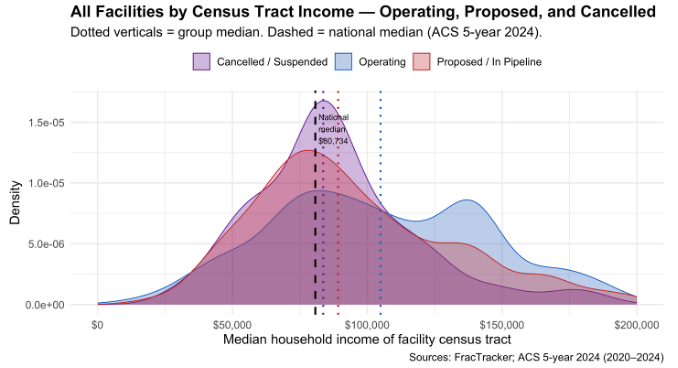
Data centers have historically been located in neighborhoods where the median household makes 30% more than the national median, but newer proposals have targeted areas closer to the national median.
The education demographics were unexpected and stark. In neighborhoods that have operational data centers, people have college degrees at 1.5x the national average; for proposed and cancelled data centers, the rate of college degrees is 10% or 20% below the national average. These new data centers are targeting less-educated areas.
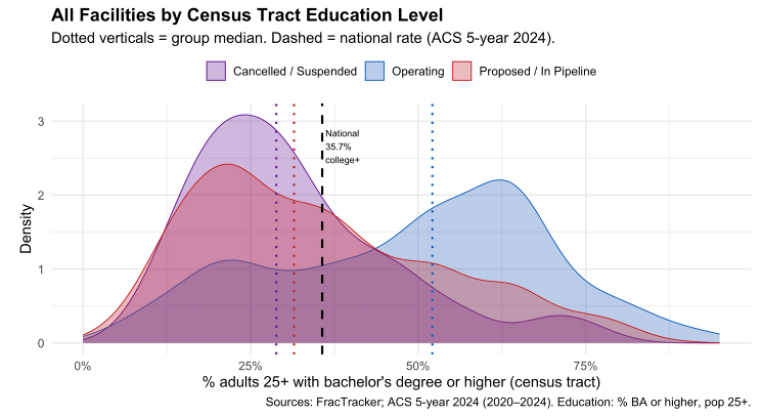
Existing data centers are clustered in super-high-educated neighborhoods, but proposals for new data centers tend to target areas short on college degrees
So, okay: Data centers are being proposed in areas with incomes slightly above the median and college education rates below the median. But like,
Where are folks opposing data centers?
Buck argues that wealthier and more-educated people are more likely than poorer or less-educated people to oppose local data centers. Well, ‘argues’ is a strong word—she just kind of says it. That’s her intuition, and she’s entitled to that, but I didn’t initially share her strong intuition, because once again I didn’t initially have any strong intuition.
Sure, rich people generally don’t like ugly, loud, smoke-spewing structures in their neighborhoods. But then again, I have no idea what your average data center looks, sounds, or smell like… and I have no reason to think it isn’t beautiful, silent, and redolent of roses.
I also know that people often like to work near their homes, but I don’t know how many six-figure jobs a typical data center creates, how many minimum wage jobs it creates, or what kind of education a person needs to work at one. To the extent that I think middle-class, overeducated people probably don’t want data centers in their neighborhoods, I’m basically just thinking about myself. This is called an egocentric bias, and it’s not pathological, but I wish news outlets didn’t treat it as an unbiased intuition, let alone a generalizable claim about the outside world.
But so the data pretty strongly contradicts Buck here, and produced a chart I found super-interesting. I actually found it surprising—and it’s hard to be surprised when you don’t have any expectations you can verbalize—but here we are.
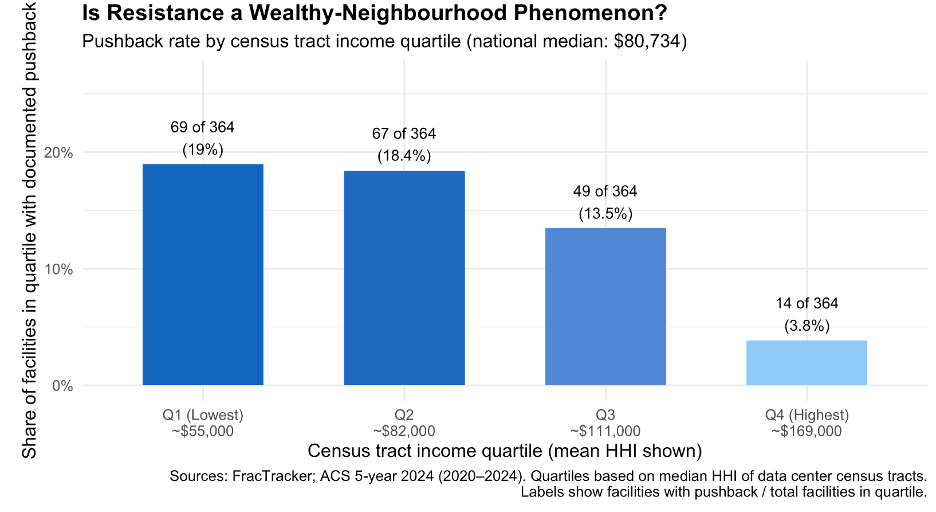
Wealthier neighborhoods appear to present less resistance to proposed data centers than less-wealthy neighborhoods do.
It seems that people with high incomes don’t give a damn if you build your data center in their backyard. In neighborhoods with below-median wealth, almost one in five data centers faces resistance. In top-quartile neighborhoods, resistance shows up again fewer than one in twenty-five data centers.
How effective is opposing data centers?
So now I’m fully on team Regunburg—Buck’s guesses are wrong, Regunburg’s are right—and I want to see what else I can do for my team (which does not, in fact, know I am on it). Public Citizen (founded by Ralph Nader in 1971) could surely get a boost if it turns out that resistance to the data center buildout actually helps stave it off. The data I have on this are limited, but pretty impressive for a first pass.
About one in four (27%) efforts to resist a new data center were associated with cancelled or suspended projects. Of projects that were cancelled or suspended, more than half (58.5%) faced documented pushback at some point. Of project that remain live in the pipeline, just one in six (16.5%) did. Protesting a data center isn’t guaranteed to get the project cancelled, but it sure seems at least as effective as the alternative.

That alternative—to let companies put data centers up wherever they want—is exactly what they do in neighborhoods with lots of college degrees.
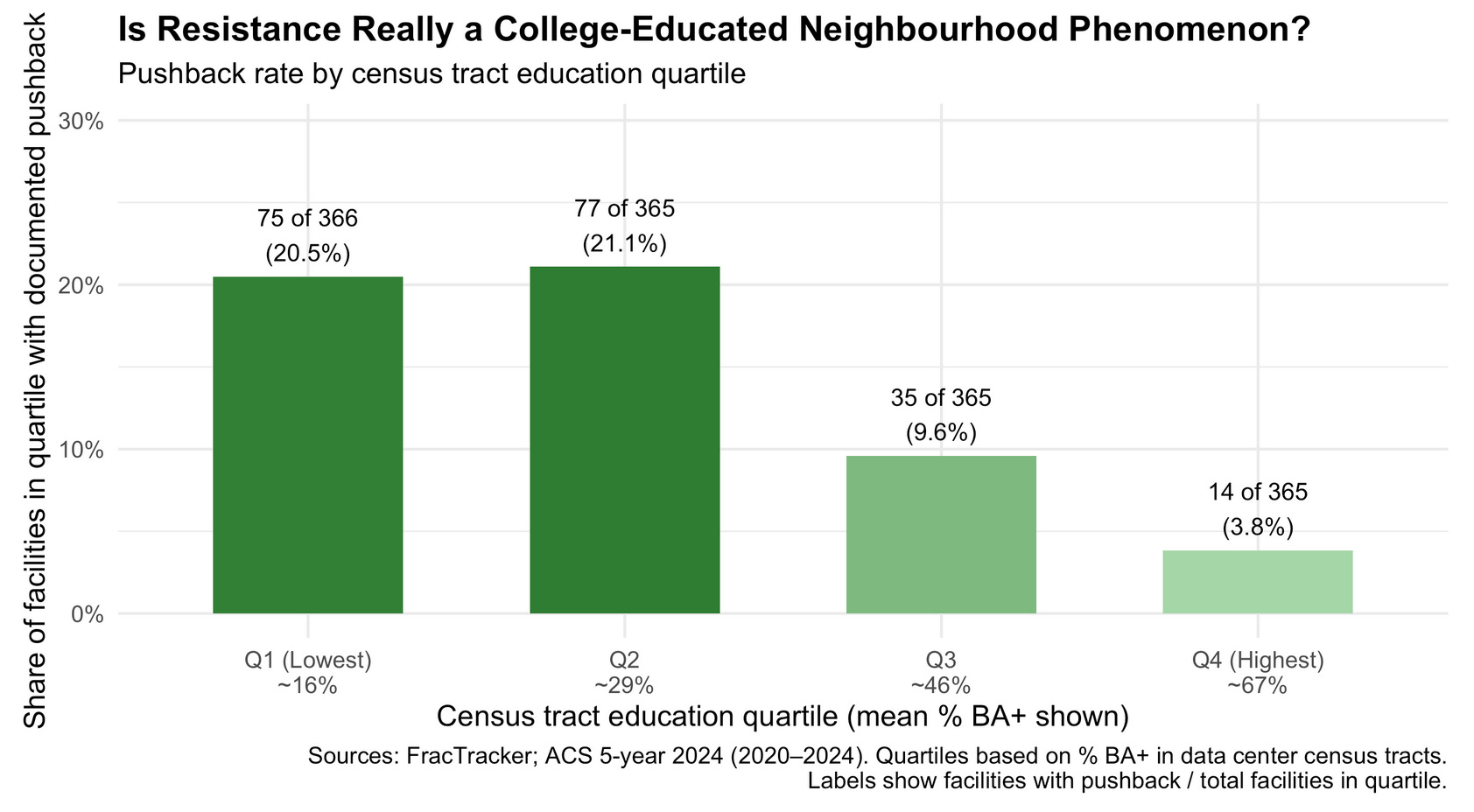
The answer to this figure’s titular question is “apparently not.”